Benefits of Design Project Management Software in 2026

TL;DR:
Design project management software streamlines workflows, reduces scope creep, and improves budget compliance for interior design firms. It enhances team collaboration, protects creative time, and standardizes reporting to build client trust. Firms adopting purpose-built systems see higher project completion rates within budget and fewer revision losses.
Design project management software is defined as a purpose-built platform that organizes creative workflows, controls revisions, and tracks budgets across the full lifecycle of an interior design project. The benefits of design project management software go far beyond basic task lists. Firms using specialized systems ship 41% more projects per designer and report 27% fewer lost revisions. Budget compliance jumps from 46% to 67% when project management maturity is high. For interior design professionals managing complex procurement cycles, client approvals, and multi-trade coordination, that gap is the difference between a profitable firm and one that quietly bleeds revenue.
1. Benefits of design project management software for planning and scheduling

Scope creep is the single biggest threat to design project profitability. Design projects experience a 45% rate of scope creep, which drives 15% budget overruns and an average 12-week timeline delay. That is not a minor inconvenience. It is a structural problem that compounds across every project your firm runs.
Specialized software addresses this through documented revision histories and approval gates. Every change request is logged, dated, and tied to a client sign-off. That paper trail makes it nearly impossible for a client to claim they never approved a direction. It also gives your project manager the evidence needed to issue a legitimate change order.
Project outcome | Without PM software | With PM software |
|---|---|---|
Budget compliance rate | 46% | 67% |
Scope creep incidence | High (45% of projects) | Reduced via approval gates |
Average timeline delay | 12 weeks | Significantly reduced |
Lost revision incidents | Baseline | 27% fewer |
Pro Tip: Set approval gates at every major phase transition, not just at project kickoff. Requiring written sign-off before moving from schematic design to design development cuts mid-project scope disputes by a measurable margin.
Understanding interior design project management as a discipline, not just a tool, is what separates firms that consistently hit their numbers from those that don't.
2. How design software improves workflow through team collaboration
Centralized communication is the core collaboration advantage of purpose-fit project management tools. When every comment, file version, and client message lives in one dashboard, your team stops wasting hours hunting through email threads and shared drives. That time goes back into billable work.
Visibility of dependencies, risks, and bottlenecks on a shared dashboard moves firms from reactive firefighting to evidence-based decisions. A project manager can see at a glance which contractor is behind, which client approval is overdue, and which budget line is at risk. That visibility is what makes proactive management possible.
Key collaboration features that drive measurable results include:
Visual commenting on design files so feedback is tied directly to the asset, not buried in a separate email
Client portals that give clients a single place to review, approve, and respond without calling or emailing your team
Asynchronous feedback tools that let clients respond on their schedule without creating bottlenecks in your workflow
Real-time status updates visible to all team members, eliminating the need for daily check-in meetings
Integration with design tools via API so files move between your design software and your project platform without manual uploads
Pro Tip: Train clients on the portal before the project starts. A 15-minute onboarding call at kickoff reduces client-side communication friction for the entire project duration.
When your systems create a luxury client experience, clients refer more and dispute less. That is a direct revenue outcome of better collaboration infrastructure.
3. Reducing revision bloat and protecting designer productivity
Revision bloat is a silent profit killer in interior design firms. Clients reopen rounds that were already approved, designers redo work without additional compensation, and project timelines stretch without any corresponding increase in revenue. This pattern is not a client problem. It is a systems problem.
Version control and client approval portals reduce reopened revision incidents by over 25%. When a client has formally approved a direction through a portal, reopening that round requires a documented change order. The software makes that boundary visible and enforceable, not just implied.
The productivity gains compound beyond revision control. Structured PM processes free designers from the mental load of chasing status updates, following up on approvals, and managing their own inboxes as a project tracking system. That cognitive relief translates directly into deeper creative focus and higher-quality output.
Productivity metric | Before software adoption | After software adoption |
|---|---|---|
Projects shipped per designer | Baseline | 41% increase |
Lost revision incidents | Baseline | 27% reduction |
Time spent on status chasing | High | Significantly reduced |
Creative focus time | Fragmented | Protected by structured workflows |
The software designers use to manage their firms matters less than whether the team actually uses it as the single source of truth. A platform that enforces revision limits only works when the team stops maintaining parallel spreadsheets.
4. How project management tools professionalize design teams
Professional credibility with clients and stakeholders is a direct outcome of standardized project reporting. When your firm presents a project portfolio, a risk register, and a delivery forecast, you are speaking the language that executive clients and developers understand. That translation layer is what makes design work defensible at the boardroom level.
Standardized reporting and professional terminology in PM software make design decisions more trustworthy to senior stakeholders. A client who can see a documented audit trail of every revision, approval, and change order is far less likely to dispute your invoice or question your process. That transparency builds the kind of trust that generates repeat business and referrals.
The specific features that professionalize your firm's output include:
Audit trails that log every decision, approval, and change request with timestamps and user attribution
Delivery forecasts that give clients a realistic, data-backed view of project timelines rather than verbal estimates
Risk registers that document known project risks and your mitigation plan, reducing client anxiety
Version control that prevents confusion over which design iteration is current and approved
Standardized change order workflows that make scope additions feel like a normal business process rather than a confrontation
The designer-builder alliance also benefits from this professionalism. When your project documentation is clean and standardized, contractors and builders can execute with fewer clarification calls and fewer costly mistakes.
Design firms with high PM maturity complete 67% of projects within budget, compared to 46% in low-maturity organizations. That 21-percentage-point gap is not explained by talent. It is explained by systems.
Key takeaways
Design project management software is the most direct lever interior design firms have for improving budget compliance, protecting creative output, and building client trust at scale.
Point | Details |
|---|---|
Scope creep is measurable and preventable | Approval gates and revision histories cut the 45% scope creep rate that drives budget overruns. |
Budget compliance doubles with PM maturity | Firms with structured systems complete 67% of projects on budget versus 46% without them. |
Revision bloat costs real money | Version control and client portals reduce reopened revision rounds by over 25%. |
Productivity gains are documented | Teams using purpose-fit software ship 41% more projects per designer with 27% fewer lost revisions. |
Professionalism is a system, not a personality | Standardized reporting and audit trails make design decisions defensible to any stakeholder. |
What I've learned from watching firms adopt PM software
The firms that get the most out of project management software are not the ones with the most features turned on. They are the ones that made a firm decision to abandon their shadow systems.
Every design firm I have observed has a version of the same problem. The project manager keeps a personal spreadsheet. The lead designer tracks revisions in a shared Google Doc. The principal manages client approvals through a personal email inbox. The software gets purchased, the team gets trained, and then within six weeks, the old habits return. The dashboard becomes a reporting tool rather than a working tool, and the real project lives somewhere else.
The behavioral shift is harder than the technical one. Choosing a platform that integrates via API with the design tools your team already uses reduces the friction of adoption. When files move automatically between your design software and your project platform, the dashboard becomes the natural place to work rather than an extra step.
I have also seen firms overcorrect. They buy enterprise-level platforms with feature sets designed for construction management or software development, then spend months trying to configure them for interior design workflows. The better path is a purpose-built tool that handles the specific vocabulary of design projects: procurement timelines, FF&E tracking, revision rounds, and client approval cycles. Generic platforms can be bent to fit, but the bending takes time your team does not have.
The creative freedom argument against PM software is the one I hear most often, and it is the one I find least convincing. Structure does not constrain creativity. It contains it, in the best sense. When your team is not chasing approvals or rebuilding lost files, they are designing. That is the point.
— Timothy
Workroom: built for the way design firms actually work
Interior design firms need a project management platform that understands procurement cycles, revision rounds, and client approval workflows without requiring months of custom configuration.
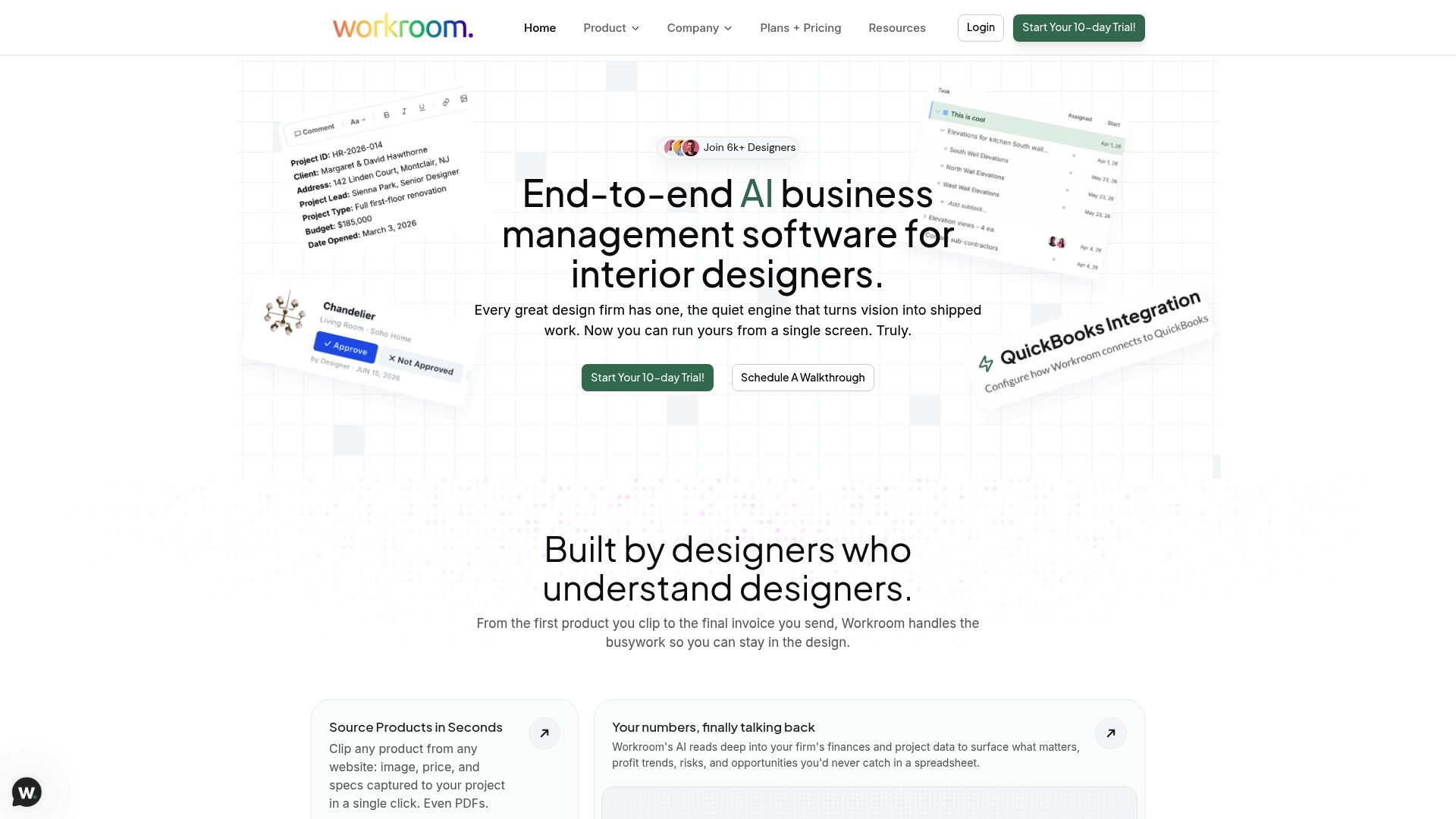
Workroom is end-to-end AI business management software built specifically for interior designers. It handles project management for design firms from initial scope through final delivery, with built-in revision tracking, client portals, budget monitoring, and procurement management in one place. Your team gets a single source of truth. Your clients get a professional experience. Your firm gets the budget compliance numbers that separate high-maturity firms from the rest. See what Workroom does for firms like yours.
FAQ
What is design project management software?
Design project management software is a platform built to manage the specific workflows of creative projects, including revision tracking, client approvals, procurement timelines, and budget control. It differs from general PM tools by including features tailored to design disciplines like interior design.
How does PM software reduce scope creep in design projects?
Documented revision histories and approval gates require clients to formally sign off before work advances to the next phase. This process creates an enforceable boundary that reduces the 45% scope creep rate common in design projects.
Does project management software limit creative freedom?
Purpose-fit PM software protects creative focus by removing the administrative burden of status chasing and revision management. Structured processes give designers more uninterrupted time for creative work, not less.
How much does PM software improve budget compliance?
Design firms with high project management maturity complete 67% of projects within budget, compared to 46% in firms with low PM maturity. That gap is driven by structured approval workflows and documented change order processes.
What features matter most for interior design project management?
Client approval portals, version control, revision limits, procurement tracking, and audit trails are the features that most directly address the profit leaks common in interior design firms.