Client Onboarding Process for Interior Design Clients

The client onboarding process in interior design is the structured sequence of communication, documentation, and alignment activities that transforms a signed contract into a project ready to execute. Done well, it prevents scope creep, eliminates mid-project surprises, and builds the trust that keeps clients engaged from concept through installation. Professional studios treat onboarding as the foundation of every project, not a formality. The steps you complete in the first two weeks directly determine how smoothly the rest of the project runs.
What are the essential elements of the client onboarding process in interior design?
Five core elements must be in place before any creative work begins. Collecting these prerequisites before the design phase prevents scope creep and revision spirals that cost both time and money. Skipping even one of them creates gaps that surface later as delays, disputes, or budget overruns.
Here is what every client should expect to provide and confirm during intake:
Signed agreement. The contract defines scope, fees, revision limits, and ownership of deliverables. No design work starts without it.
Paid deposit. A deposit confirms financial commitment and funds the early project phases, including research and procurement planning.
Completed design brief questionnaire. This document captures your style preferences, functional requirements, budget parameters, and lifestyle needs. The more specific your answers, the fewer revision cycles follow.
Identified decision-makers. Every person with final approval authority must be named before the project starts. Undisclosed decision-makers are one of the most common causes of late-stage revisions.
Site documentation. Floor plans, measurements, photographs, and any existing architectural drawings give the design team the technical baseline they need.
Proposals from most professional studios expire within 14–21 days. That window exists to protect both parties from cost changes in materials and labor. Treat the proposal expiry date as a real deadline, not a formality.
Prerequisite | Purpose | Typical turnaround |
|---|---|---|
Signed agreement | Defines scope and protects both parties | Within 3 days of proposal acceptance |
Paid deposit | Funds early project phases | Same day as contract signing |
Design brief questionnaire | Captures preferences and requirements | Within 24 hours of contract signing |
Decision-maker identification | Prevents late-stage approval conflicts | Confirmed at discovery call |
Site documentation | Provides technical baseline for design | Within 5 days of contract signing |

Pro Tip: Submit your site documentation and questionnaire together. Designers who receive both at once can begin concept development immediately, cutting days off the early project timeline.
How does the design project onboarding workflow progress from inquiry to kickoff?
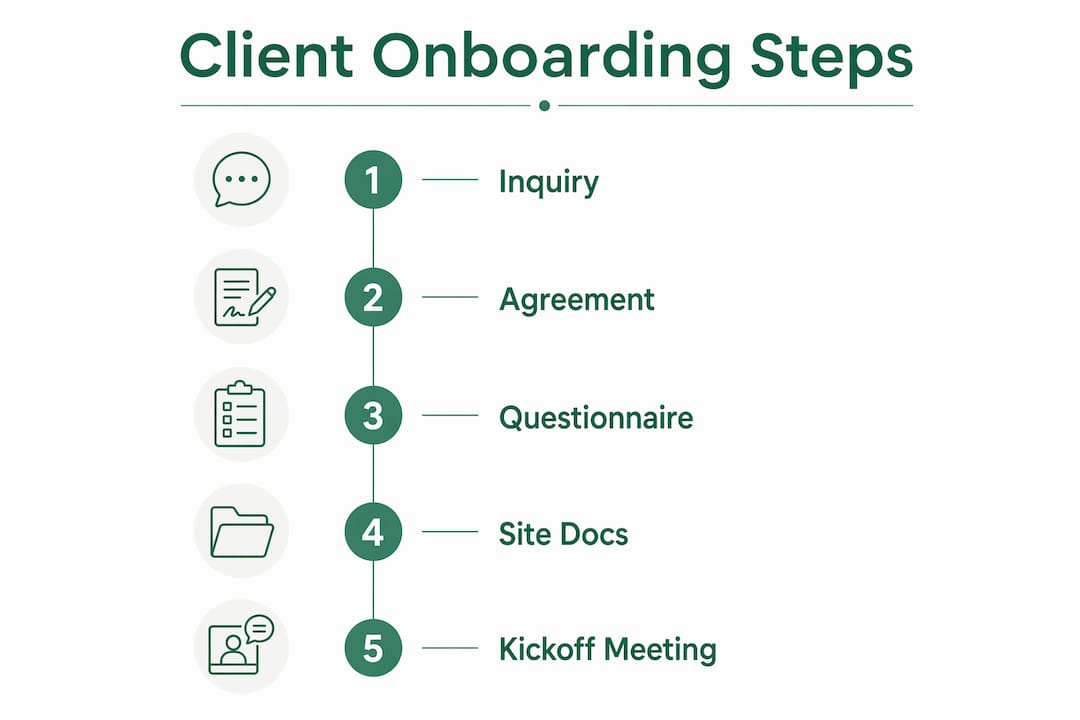
A well-run onboarding follows a predictable sequence. Each step builds on the last, and skipping ahead creates misalignment that costs far more to fix than to prevent.
Automated inquiry response. A professional studio responds to your initial inquiry within one hour. This automated acknowledgment confirms receipt and sets expectations for next steps.
Discovery call (15–30 minutes). This call is a qualification filter, not a sales pitch. Discovery calls focus on budget and authority before any design hours are committed. The designer confirms your budget range, project scope, and who holds final decision-making authority.
Proposal delivery and contract signing. After the discovery call, the studio sends a formal proposal. Once you sign and pay the deposit, the project officially begins.
Questionnaire delivery within 24 hours. Sending the design brief digitally within 24 hours of contract signing prevents momentum loss and captures your preferences while they are fresh.
Budget alignment meeting. Before concept development begins, the designer reviews your questionnaire responses and confirms that your budget aligns with your stated goals. This meeting prevents the painful conversation that happens when a $50,000 budget meets a $120,000 wish list.
Kickoff meeting (45–90 minutes). The kickoff meeting marks the formal start of creative work. All final decision-makers must attend this meeting. Absent stakeholders are the single most common cause of mid-project revisions and added costs.
Pro Tip: Treat the discovery call as your interview of the designer, not the other way around. Ask directly about their revision policy, communication cadence, and how they handle scope changes. The answers reveal how the entire project will run.
Most studios deliver mood boards or initial concepts within one week of a complete kickoff. That timeline depends entirely on receiving all five prerequisite documents on schedule.
What tools and strategies improve communication during client onboarding?
Technology has changed how interior design client intake works. The most effective studios no longer manage onboarding through email threads and PDF attachments. They use centralized client portals that collect contracts, questionnaires, and site documentation in one place.
Centralized client portals reduce administrative burden by automating reminders, tracking document completion, and giving both parties a single source of truth. When a client uploads floor plans or signs a contract inside a portal, the designer sees it immediately. No follow-up emails, no lost attachments.
The spec book or project binder serves a similar function during and after the kickoff meeting. It contains all technical specifications, material selections, and vendor contacts in one document. Contractors and clients reference the same source, which eliminates the feedback loops that slow construction phases.
Here is how different onboarding methods compare in practice:
Method | Strengths | Weaknesses |
|---|---|---|
Email-based | Familiar, low barrier to entry | Documents get buried, versions multiply |
Portal-based | Centralized, trackable, automated reminders | Requires client to adopt new platform |
Hybrid (email + shared folder) | Flexible, accessible | No automation, relies on manual follow-up |
Best practices for clients engaging with onboarding tools:
Log into the client portal within 24 hours of receiving access credentials.
Complete the questionnaire in one session rather than saving partial answers.
Upload all site documentation as a single organized folder, not individual files sent over days.
Confirm portal notifications are enabled so you receive automated reminders.
Designate one point of contact on your end to communicate with the design team.
Interior design project management software built specifically for designers handles all of these workflows in one place, reducing the back-and-forth that slows early project phases.
What onboarding mistakes cause the most project delays?
Most project delays trace back to the first two weeks. The mistakes clients make during onboarding create problems that compound throughout the entire project lifecycle.
Incomplete document submission is the most common delay trigger. A designer cannot begin concept development without site measurements and a completed questionnaire. Submitting partial information forces the studio to pause, follow up, and restart, adding days or weeks to the schedule.
Decision fatigue from poorly structured questionnaires is a real risk. Avoid overwhelming clients with open-ended questions. Curated options with visual examples produce better answers than blank text fields. If your designer sends a questionnaire with 40 open-ended questions, ask for a revised version with structured choices. Better input produces better design.
Excluding key decision-makers from early meetings is a costly mistake. A spouse, business partner, or property owner who was not part of the discovery call or kickoff meeting will inevitably request changes after seeing the first concept. Those changes are expensive. Kickoff meetings require all stakeholders to prevent exactly this outcome.
"Onboarding is not paperwork. It is the phase where trust is built or broken. Clients who engage fully in the first two weeks experience fewer surprises, fewer revisions, and better outcomes." — Principle from professional studio practice
Pro Tip: Before your kickoff meeting, review the questionnaire responses with every decision-maker in your household or organization. Conflicting preferences are far cheaper to resolve before design begins than after the first concept presentation.
Additional mistakes to avoid:
Delaying contract signing past the proposal expiry window, which can trigger repricing.
Providing aspirational budgets rather than actual available funds.
Assuming verbal agreements made during the discovery call are binding without written confirmation.
Key takeaways
A structured client onboarding process in interior design is the single most reliable predictor of a smooth, on-budget, on-schedule project outcome.
Point | Details |
|---|---|
Five prerequisites are non-negotiable | Signed contract, deposit, questionnaire, decision-makers, and site docs must all be complete before design begins. |
Discovery calls qualify, not pitch | Use the discovery call to confirm budget alignment and decision-making authority before committing to the project. |
All stakeholders must attend kickoff | Absent decision-makers at the kickoff meeting are the leading cause of costly mid-project revisions. |
Portals outperform email for intake | Centralized portals automate reminders, track submissions, and eliminate document version confusion. |
Questionnaire quality drives design quality | Curated, structured questions produce better client input and reduce revision cycles throughout the project. |
Why onboarding is the most underrated phase of any design project
Clients often arrive at the onboarding phase eager to see concepts and frustrated by what feels like administrative delay. I understand that impulse completely. But after watching dozens of projects unfold, the pattern is clear: the projects that run smoothly are the ones where the client treated onboarding as seriously as the design itself.
Onboarding is a trust-building phase, not just a checklist. The way a studio handles your first two weeks tells you everything about how they will handle a difficult vendor situation in month four. A studio that sends a clear contract, a well-structured questionnaire, and a portal login within 24 hours of signing is a studio that runs a disciplined operation.
The mistake I see clients make most often is treating the questionnaire as optional or rushing through it. That document is the designer's primary source of information about who you are and what you need. Vague answers produce vague concepts. Specific answers produce work that feels like it was made for you.
My honest advice: before you sign anything, ask the studio to walk you through their onboarding sequence step by step. If they cannot describe it clearly, that is a signal. The best studios have a defined client management process that they can explain in under five minutes. That clarity is not bureaucracy. It is professionalism.
— Timothy
How Workroom supports your onboarding from day one
Interior design clients who work with studios using Workroom experience a noticeably different onboarding process. The platform handles contract delivery, digital signatures, intake questionnaires, and document collection inside a single client portal.
Designers using Workroom send questionnaires within 24 hours of contract signing, track document submissions automatically, and run kickoff meetings with all materials pre-loaded and accessible. Clients spend less time chasing emails and more time making decisions that move the project forward. If your current studio's onboarding feels disorganized, ask whether they are using purpose-built interior design software to manage the process. The difference in your experience will be immediate.
FAQ
What is client onboarding in interior design?
Client onboarding in interior design is the structured process of collecting contracts, deposits, questionnaires, and site documentation before creative work begins. It establishes clear communication, scope, and expectations between the client and the design team.
What should a client onboarding checklist include?
A complete interior design client onboarding checklist includes a signed agreement, paid deposit, completed design brief questionnaire, identified decision-makers, and site documentation such as floor plans and measurements.
How long does the onboarding process take?
A complete onboarding typically takes 5–10 days from contract signing to kickoff meeting. The timeline depends on how quickly the client submits the questionnaire and site documentation.
Why must all decision-makers attend the kickoff meeting?
Absent stakeholders at the kickoff meeting are the leading cause of mid-project revisions. When all decision-makers align on scope and direction at the start, costly changes later in the project are far less likely.
What is a design brief questionnaire?
A design brief questionnaire is a structured document sent by the designer within 24 hours of contract signing. It captures the client's style preferences, functional requirements, budget parameters, and lifestyle needs to guide the entire design process.