Sourcing Workflow Design: A Guide for Project Managers

A sourcing workflow design is the deliberate structuring of procurement steps to produce predictable, efficient, and risk-mitigated sourcing outcomes. Project managers and operational leads who treat procurement as a series of ad hoc decisions pay for it in rework, missed deadlines, and supplier disputes. The industry standard for this process is a structured 7-step framework covering needs identification through performance monitoring.
Workroom applies these same workflow design principles to interior design procurement, where sourcing decisions directly affect project margins and client timelines. Getting the design right from the start is the difference between a procurement function that runs itself and one that quietly drains your capacity.
What is a sourcing workflow design and why does it matter?
A sourcing workflow design is a documented, repeatable map of every task, decision point, and approval required to move a procurement need from identification to fulfilled contract. The industry term for this practice is strategic sourcing process design, and it sits at the intersection of process engineering and procurement strategy. Understanding what is a sourcing workflow design means recognizing that it is not just a checklist. It is a structural decision about how your organization handles risk, cost, and supplier relationships at scale.
Organizations that skip formal workflow design tend to rely on tribal knowledge. One project manager knows which supplier to call; another does not. When that person leaves, the process leaves with them. A documented sourcing workflow design converts institutional knowledge into repeatable infrastructure that any trained team member can execute.

The business case is direct. Structured workflows reduce costs and risks by removing ambiguity from high-stakes procurement decisions. Every step has a defined owner, a defined output, and a defined trigger for the next step. That clarity alone eliminates a significant share of procurement delays.
What are the essential steps in a sourcing workflow design?
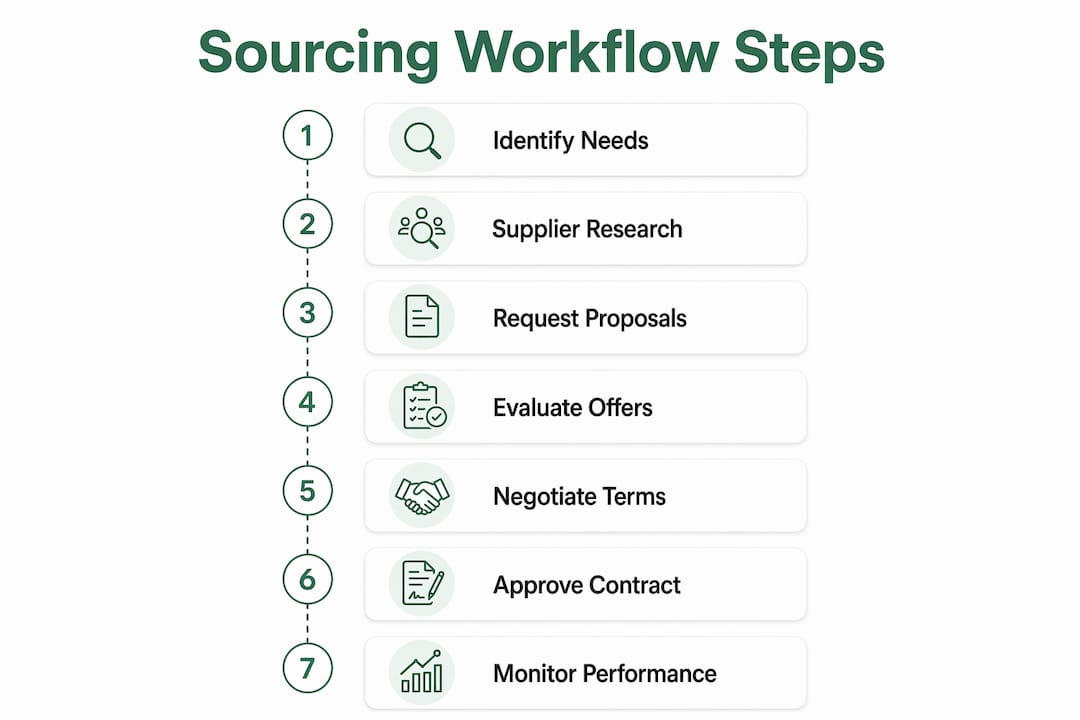
The 7-step strategic sourcing workflow is the most widely adopted framework in procurement process design. Each step builds on the last, and skipping any one of them creates downstream problems that are expensive to fix.
Needs identification. Define exactly what is required, in what quantity, by what date, and to what specification. Vague needs produce vague supplier responses.
Market research. Analyze the supplier market to understand pricing benchmarks, lead times, and supply risk. This step prevents your team from negotiating blind.
Strategy development. Decide how you will source: single supplier, competitive bid, or negotiated contract. The strategy must match the risk profile of the category.
RFx events. Issue Requests for Information (RFI), Requests for Proposal (RFP), or Requests for Quote (RFQ) depending on the complexity of the purchase. Each format serves a different information need.
Negotiation. Use the data from your RFx responses to negotiate price, terms, and service levels. Negotiation without market data is guesswork.
Contract execution. Formalize the agreement with clear deliverables, payment terms, and performance expectations. A contract without measurable terms is unenforceable in practice.
Performance monitoring. Track supplier delivery against contract terms and feed that data back into the next sourcing cycle. This step closes the loop and makes the workflow self-improving.
Variations exist across industries. Interior design firms, for example, often compress steps 4 and 5 for smaller purchases and expand step 7 to include client-facing delivery tracking. The core sequence, however, holds regardless of firm size or category complexity.
What are the fundamental workflow design principles critical for sourcing?
Effective sourcing process design starts with business outcomes, not tools. Organizations that build tools around broken workflows accelerate their inefficiencies rather than fix them. The principles below apply whether you are designing a workflow from scratch or auditing an existing one.
Start from outcomes, not features. Define what a successful procurement cycle looks like before selecting any platform or automation tool. The workflow must serve the business goal, not the software's default settings.
Map real work, not assumed work. Most organizations document their ideal process. Actual operations differ significantly from that ideal. Observe how your team actually sources before you codify anything.
Treat human involvement as a design decision. Every approval gate, review step, and escalation path requires a human. Design those touchpoints deliberately, with clear criteria for when a human must intervene versus when automation can proceed.
Design for exceptions, not just the happy path. Exceptions are not failures. They are data. A workflow that cannot handle a late supplier response or a budget change mid-cycle will break under normal operating conditions.
Build for modularity. Each step in your workflow should be replaceable without rebuilding the entire process. When your RFx process changes, only that module should need updating.
Pro Tip: Before mapping your sourcing workflow, spend one week observing your team's actual procurement behavior. Note every workaround, every informal approval, and every step that bypasses the documented process. Those gaps are your real design brief.
The most common mistake in sourcing workflow design is codifying the process as it should work rather than as it does work. The result is a workflow that looks correct on paper and fails in practice every time conditions deviate from the ideal.
How do digital tools and automation enhance sourcing workflow design?
Digital sourcing workflows are business processes that dictate task flow, document routing, and approval hierarchies to produce consistent procurement outcomes. Moving from manual to digital does not change the underlying workflow logic. It makes that logic visible, trackable, and auditable.
The core benefits of digital workflow systems in sourcing are:
Consistency. Every procurement request follows the same path regardless of who initiates it.
Transparency. Stakeholders can see the status of any sourcing event at any point in the cycle.
Measurable outcomes. Digital systems generate data on cycle times, approval delays, and exception rates that manual processes cannot produce.
Automation design principles like modularity, observability, and error handling determine whether a workflow becomes dependable infrastructure or a fragile liability. A modular workflow can be updated one step at a time. An observable workflow surfaces problems before they become failures. An error-handling workflow routes exceptions to the right human rather than dropping them.
Design principle | What it means in practice |
|---|---|
Modularity | Each workflow step can be updated independently |
Observability | Status and errors are visible at every stage |
Error handling | Exceptions route to a defined owner, not a dead end |
Documentation | Every automation step has a clear name and purpose |
Digital workflows that combine automation with human gates produce better outcomes than fully automated or fully manual processes. The key is deciding at design time which decisions require human judgment and which can be safely automated.
Pro Tip: Never automate a step you have not first run manually at least ten times. Automation locks in your current process. If that process has flaws, automation makes those flaws permanent and harder to see.
What are best practices and common pitfalls in implementing sourcing workflow designs?
The most reliable implementation approach is to start with one workflow category or a single supplier group. This incremental method lets your team prove value quickly, build organizational support, and identify design gaps before scaling. Trying to redesign all procurement workflows simultaneously is the fastest path to stalled adoption.
Track three metrics from day one of any new sourcing workflow:
Cycle time. How long does it take to move from needs identification to contract execution? Reduction here is the clearest proof of workflow value.
Rework rate. How often does a procurement request get sent back for missing information or incorrect approvals? High rework rates signal a design flaw, not a people problem.
Exception frequency. How often does the workflow hit a condition it was not designed to handle? Frequent exceptions mean your design does not reflect real operations.
Minimizing handoffs, ensuring clear ownership, and monitoring performance continuously are the three practices that separate workflows that improve over time from those that degrade. Every handoff is a potential delay. Every undefined ownership gap is a potential dropped task.
The most common pitfalls in sourcing workflow implementation are:
Codifying a broken process without fixing it first
Ignoring the gap between documented and actual workflows
Over-automating before the manual process is stable
Failing to build feedback loops that allow the workflow to evolve
Stakeholder engagement is not optional. The people who execute the workflow daily will find its flaws within the first month. Build a formal feedback channel into your implementation plan and review it on a fixed schedule.
Key takeaways
A sourcing workflow design is a structured, repeatable procurement process that reduces cost, risk, and rework when built around real operational behavior rather than assumed ideal flows.
Point | Details |
|---|---|
Use the 7-step framework | Cover needs identification through performance monitoring to create a complete sourcing cycle. |
Map real workflows first | Observe actual procurement behavior before documenting or automating any process. |
Design for exceptions | Treat unexpected conditions as structural data, not failures, and route them to defined owners. |
Start with one category | Prove workflow value on a single supplier group before scaling across the organization. |
Automate after stabilizing | Only automate steps that have run reliably in manual form to avoid locking in flawed processes. |
Why most sourcing workflows fail before they start
The uncomfortable truth about sourcing workflow design is that most teams skip the observation phase entirely. They sit in a conference room, map the process they believe exists, and then build a digital system around that map. Six months later, the system is underused and the team has reverted to email chains and spreadsheets.
I have seen this pattern in firms of every size. The problem is not the technology and it is not the team. The problem is that the workflow was designed for a fictional version of the organization. Real procurement involves informal approvals, supplier relationships that bypass formal channels, and budget exceptions that no one documented. A workflow that ignores those realities will be worked around immediately.
The firms that get this right share one habit: they treat workflow design as a research project before it becomes a build project. They watch, they ask, and they document what actually happens. Only then do they start designing. That sequence sounds obvious, but it is genuinely rare.
Modularity matters more than most teams realize. A sourcing workflow you cannot update without rebuilding from scratch will be abandoned the first time your business conditions change. Build each step to stand alone, and your workflow becomes an asset that compounds in value over time rather than a constraint you eventually route around.
The business process mapping discipline that underpins good sourcing workflow design is the same discipline that separates high-performing design firms from reactive ones. The firms that invest in it early spend less time firefighting and more time delivering.
— Timothy
How Workroom supports your sourcing workflow
Interior design firms carry a procurement burden that most project management tools were not built to handle. Vendor approvals, purchase order tracking, and client-facing delivery timelines all run through the same sourcing cycle, and a missed step in any one of them affects the project margin.
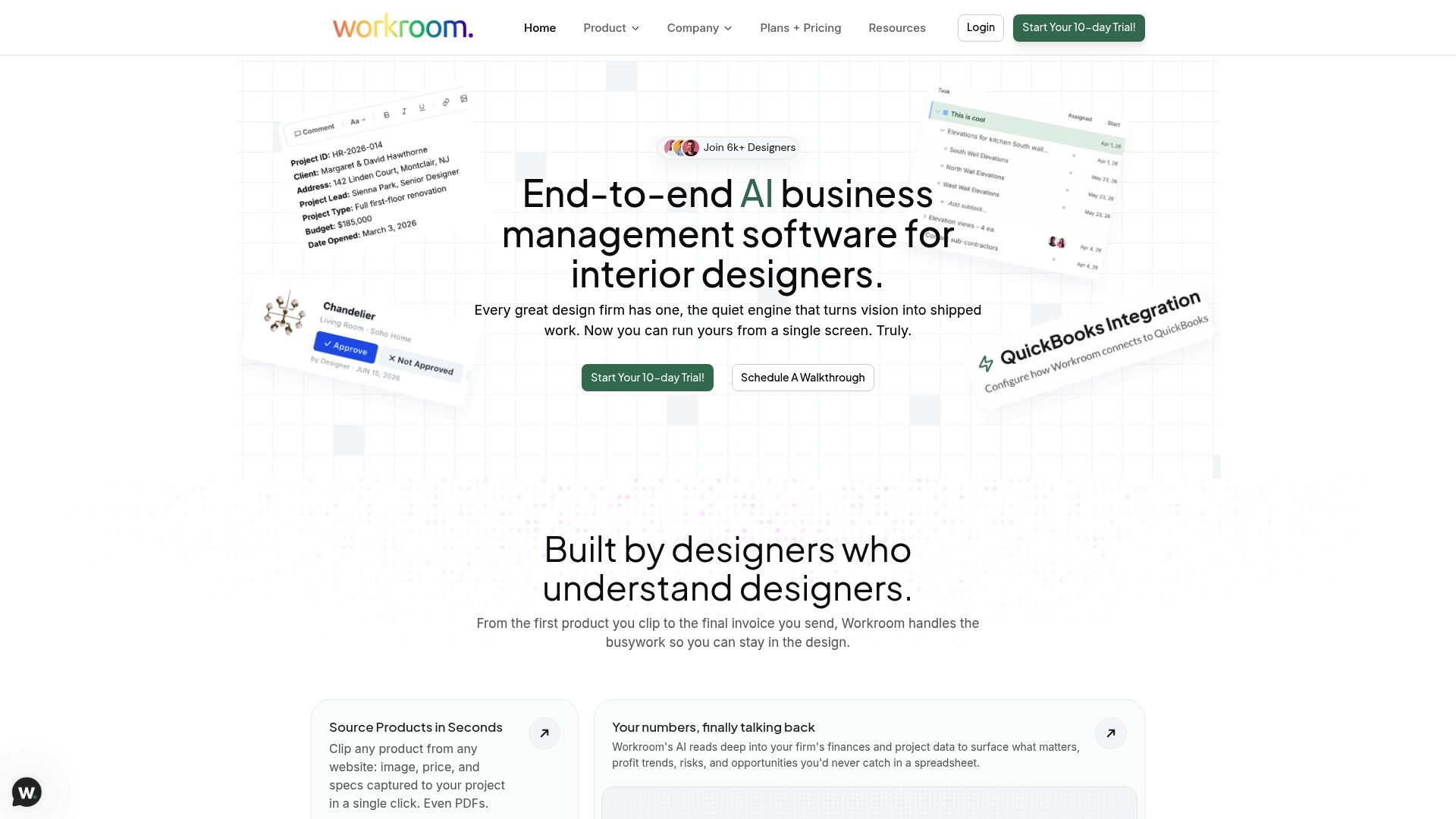
Workroom is built specifically for design firms that need end-to-end visibility across their sourcing and project workflows. From task assignment and approval routing to procurement tracking and client communication, the platform keeps every step of your sourcing process on a single screen. You can book a walkthrough to see how the workflow tools map to your firm's actual procurement cycle. For firms ready to move from reactive sourcing to a repeatable process, Workroom is the operational foundation that makes it possible.
FAQ
What is a sourcing workflow design?
A sourcing workflow design is a structured map of every task, approval, and decision required to complete a procurement cycle. It follows a 7-step framework from needs identification through supplier performance monitoring.
How does sourcing workflow design differ from a standard procurement process?
A standard procurement process describes what to buy and from whom. A sourcing workflow design specifies the exact sequence of steps, owners, and decision rules that govern how procurement happens consistently across every purchase.
What is the biggest mistake in sourcing workflow design?
The most common mistake is codifying an ideal process rather than the actual one. Workflows built on assumed behavior fail under real operating conditions and get bypassed immediately.
When should automation be added to a sourcing workflow?
Automation should be added only after a step has run reliably in manual form. Automation locks in your current process, so automating an unstable step makes its flaws permanent and harder to diagnose.
How do you measure the success of a sourcing workflow?
Track cycle time from needs identification to contract execution, rework rate on procurement requests, and exception frequency. Improvement in all three metrics confirms the workflow is functioning as designed.
Recommended
Workroom vs Gather: Interior Design Software Comparison (2026)
Workroom vs Design Manager: Interior Design Software Comparison (2026)