How an Interior Design Company Can Scale Without Chaos

Growth is the goal for most design firm owners, but it often arrives disguised as a problem. More inquiries, larger projects, additional team members, and bigger budgets can feel exciting at first. Then the cracks start to show: project details live in too many places, procurement updates are hard to track, clients ask for decisions that were already made, and the principal designer becomes the bottleneck for everything.
Scaling an interior design company is not just about booking more work. It is about building a business that can handle more work without lowering design quality, damaging client trust, or burning out the team.
The firms that scale well tend to do one thing differently: they replace heroic effort with repeatable systems. They still deliver creative, highly personal work, but the operational side of the business no longer depends on memory, scattered spreadsheets, or constant last-minute problem solving.
What “scaling without chaos” actually means
Scaling does not always mean building a large agency. For one interior design company, it may mean moving from solo founder to a small team. For another, it may mean increasing average project size, expanding procurement volume, taking on multi-room renovations, or opening a second location.
The common thread is capacity. A scalable firm can increase revenue, project complexity, or team size without every new opportunity creating an equal increase in stress.
Chaos usually appears when growth outpaces infrastructure. You may see it in missed follow-ups, unclear responsibilities, delayed approvals, surprise budget overages, or team members asking the same questions repeatedly. These are not personality problems. They are system problems.
A scalable interior design business needs structure in five areas: intake, project workflow, financial visibility, procurement, and communication. When those areas are organized, the creative work becomes easier to protect.
Know the difference between busy and scalable
Many design firms feel successful on paper but fragile behind the scenes. The calendar is full, invoices are going out, and the pipeline looks healthy. Yet the owner cannot step away for a day without everything slowing down.
That is a sign the business is busy, not scalable.
A busy firm relies on individual effort. A scalable firm relies on shared process. A busy firm answers questions as they come up. A scalable firm documents the answers before they are needed. A busy firm tracks finances after the fact. A scalable firm monitors budgets while decisions are still being made.
Use the table below to assess where your firm stands today.
Area of the business | Busy but fragile | Scalable and controlled |
|---|---|---|
Client onboarding | Each project starts differently | Every client follows a clear intake and kickoff process |
Project management | Tasks live in email, texts, and memory | Tasks, deadlines, and responsibilities are centralized |
Procurement | Product details are copied between tools | Sourcing, approvals, and purchasing are connected |
Financial tracking | Budgets are reviewed after problems appear | Budgets are visible throughout the project |
Communication | The team interrupts each other for updates | Updates are easy to find and tied to the right project |
Client experience | The principal designer explains everything manually | Clients understand next steps through a polished process |
If the right column feels far away, that does not mean your firm is failing. It means your next stage of growth requires operational design, not just more marketing.
Standardize your client journey before you add more clients
A strong client journey is one of the most overlooked scaling tools in an interior design company. When every project begins differently, your team has to reinvent expectations, timelines, and boundaries each time. That creates friction before design work even begins.
Standardization does not make the client experience feel generic. Done well, it makes the experience feel more premium because clients know what to expect and your team looks prepared at every step.
Start by mapping the full client journey from inquiry to final installation. Identify what happens during discovery, proposal, agreement, kickoff, concept development, procurement, installation, styling, and closeout. Then define what the client receives, what the team does internally, and what decisions need to happen at each phase.
This is also where boundaries matter. If clients do not understand when approvals are due, how revisions are handled, or what happens when scope changes, your team will absorb that ambiguity later. A clear design agreement helps protect the relationship before tension appears. Workroom’s article on why a design agreement is a non-negotiable is a helpful companion if your contracts and expectations need tightening.
Once the journey is mapped, look for repeatable assets. Welcome guides, kickoff checklists, project phase templates, approval instructions, and email templates can reduce manual explanation without making the service feel less personal.
Build your operating system, not just your team
Hiring can solve capacity problems, but it can also expose hidden disorganization. If your process is unclear, every new team member has to learn by watching, asking, and guessing. That slows everyone down and increases the risk of inconsistent work.
Before hiring aggressively, define how work moves through the firm. This does not need to become a complicated operations manual overnight. Start with your core workflows and document the steps that happen every time.
Important workflows for interior design firms include:
New lead qualification and consultation scheduling
Proposal creation and agreement execution
Project kickoff and internal handoff
Design development and client approvals
Product sourcing and specification
Budget updates and change tracking
Procurement, ordering, receiving, and issue resolution
Installation planning and final closeout
Each workflow should answer a few practical questions. Who owns the step? What information is required before the step can begin? Where is that information stored? What does “done” look like? What happens if the client delays, a vendor changes pricing, or an item is discontinued?
This is where many firms discover that the issue is not that people are careless. The issue is that the system asks them to remember too much.
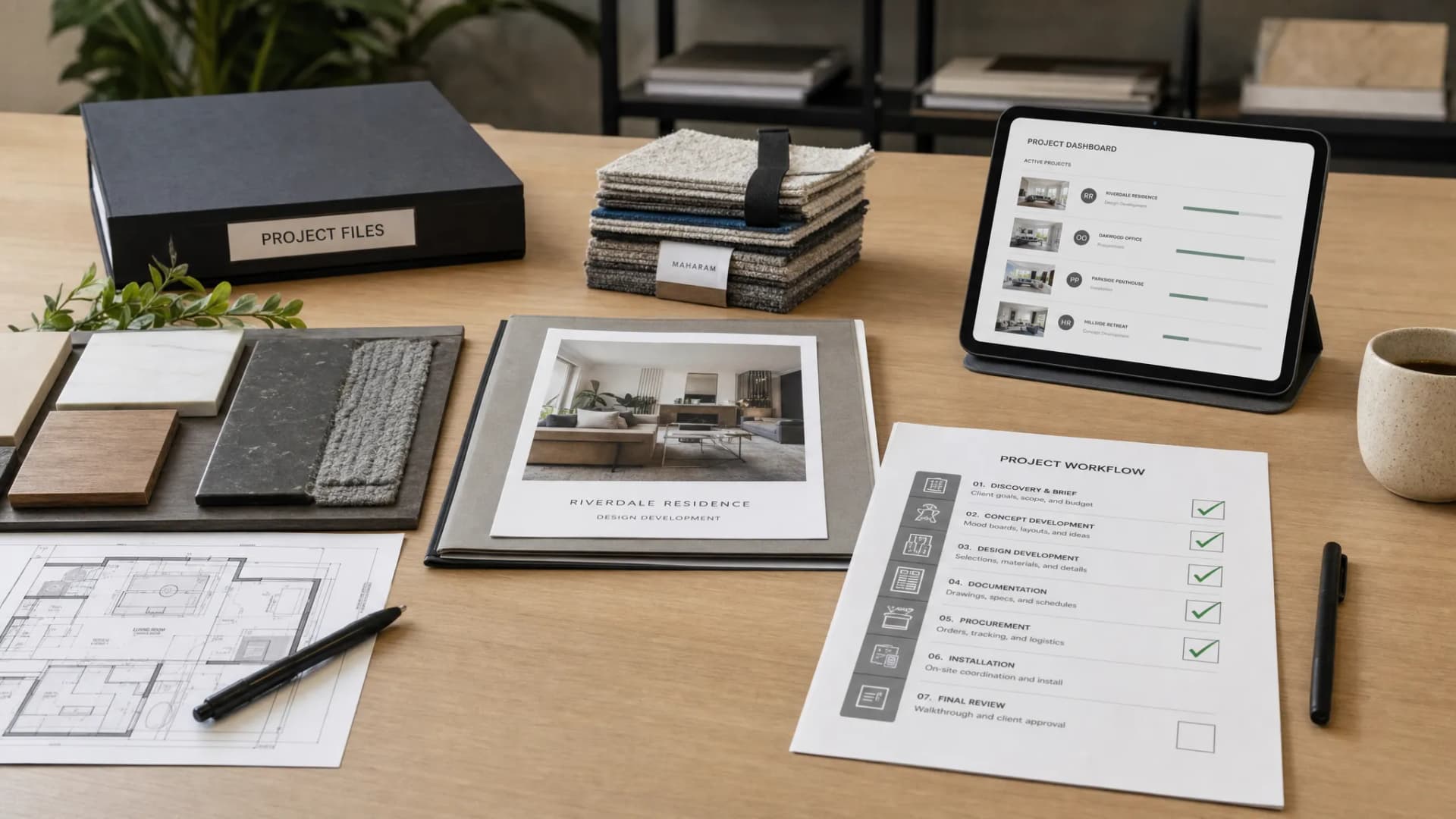
Centralize project information so decisions do not get lost
As an interior design company grows, scattered information becomes one of the most expensive sources of chaos. A finish selection might be in an email thread, the latest vendor quote in a spreadsheet, the client approval in a text message, and the budget update in accounting software. Nothing is technically missing, but everything takes too long to find.
Centralization is not about being tidy for its own sake. It protects profit, time, and trust.
When information is centralized, a designer can quickly see what was approved, what changed, what has been ordered, what is waiting on the client, and what will affect the budget. A project manager can step in without asking the principal designer for every detail. A client can review decisions in context rather than searching through fragmented messages.
For growing firms, project management software should support the way interior design work actually happens. Generic task tools can help with deadlines, but design projects also involve sourcing, approvals, procurement, budgets, invoicing, accounting, and collaboration. Workroom is built as an end-to-end business management platform for interior designers, bringing project management, sourcing, accounting, client collaboration, and communication into one system.
If you are still evaluating what operational structure looks like for a design firm, this guide to interior design project management offers a useful foundation.
Protect margins with real-time financial visibility
A firm can grow revenue and still become less profitable. This is one of the most common scaling traps in service businesses, especially in interior design where project scope, procurement complexity, freight, rush fees, client changes, and vendor delays can all affect the bottom line.
Financial clarity has to move upstream. If you only review profitability after a project closes, the opportunity to course-correct has already passed.
A scalable firm tracks financial health throughout the project lifecycle. That includes estimated versus actual hours, approved budgets, procurement costs, client invoices, vendor payments, and change orders. It also includes the less obvious costs of growth, such as software, contractors, employee time, warehousing, receiving, and administrative support.
The U.S. Small Business Administration regularly emphasizes the importance of cash flow management for small businesses because profitability and cash availability are not the same thing. A design firm may have a profitable project on paper while still struggling if deposits, vendor payments, and client billing are not timed carefully.
Financial visibility becomes even more important when multiple projects overlap. Without a shared view of budgets and obligations, the owner may make decisions based on bank balance rather than true project position.
Here is a simple financial control table to use as your firm scales.
Financial control | Why it matters | When to review it |
|---|---|---|
Project budget | Keeps design decisions aligned with client expectations | Weekly during active design and procurement |
Estimated vs. actual hours | Shows whether fees match the real workload | At each project phase |
Procurement commitments | Prevents surprise cash demands and missed billing | Before placing orders |
Change orders | Protects margin when scope expands | Immediately when scope changes |
Accounts receivable | Keeps cash flow healthy | Weekly |
Project profitability | Reveals which project types are worth repeating | At closeout and quarterly |
Workroom supports project budget tracking, built-in accounting, QuickBooks syncing, and AI financial insights, which can help firms connect project decisions with business performance instead of managing finances in a separate silo. For a deeper look at the financial side of growth, Workroom’s guide to small business financial success is worth reading.
Turn procurement into a controlled process
Procurement is where many growing design firms feel the most pressure. The volume of details is high, the dependencies are real, and clients often do not see how much work happens behind the scenes.
At a smaller scale, a designer may be able to manage product information manually. As the firm grows, that becomes risky. A missing lead time, outdated price, untracked approval, or unclear purchasing status can create delays and margin loss.
A scalable procurement process should make it easy to answer essential questions at any moment. What has been specified? What has the client approved? What has been ordered? What is backordered? What has arrived? What is damaged? What still needs payment? What affects installation?
Product sourcing capture is especially valuable because it reduces duplicate data entry and helps keep item details connected to the project. When sourcing, approvals, budgets, and purchasing are part of the same workflow, the team spends less time reconciling information and more time solving the right problems.
Procurement also needs clear roles. Decide who is responsible for vendor communication, order placement, expediting, issue tracking, client updates, and budget adjustments. If everyone is partially responsible, no one is truly accountable.
Create communication rules before communication breaks down
Growth increases the number of communication paths in your business. More clients, more vendors, more contractors, more internal team members, and more active projects mean more opportunities for important details to get buried.
The solution is not more meetings. It is clearer communication architecture.
Decide which types of communication belong where. Client approvals should not be hidden in casual text threads. Internal task updates should not depend on hallway conversations. Vendor issues should be tied to the relevant item or project. Financial questions should be connected to budgets, invoices, or purchase orders rather than floating in email.
A simple communication policy can prevent confusion. For example, your firm might decide that client-facing decisions must be documented in the project system, urgent internal updates go through Slack, and project tasks sync with tools your team already uses. Workroom supports unified team communication, Slack notifications, and syncs with Trello and Asana, which can help firms keep collaboration connected without forcing every update into one channel.
Communication also affects perceived luxury. Clients do not need to see every operational detail, but they do need to feel that the process is calm, clear, and professionally managed. If you want to connect systems with client experience, Workroom’s article on how to streamline your systems to create a luxury client experience expands on that idea.
Make the principal designer less essential to daily operations
This may be the hardest shift for a founder-led interior design company. Many firms grow because of the principal designer’s taste, relationships, judgment, and reputation. Those strengths should remain central to the brand. But if every decision, approval, answer, and escalation requires the founder, the business has a ceiling.
Scaling without chaos means separating creative leadership from operational dependency.
The principal designer should focus on the decisions where their expertise creates the most value: design direction, client relationships, creative standards, hiring, partnerships, and business strategy. The team should be able to manage documented processes, routine updates, procurement tracking, and project coordination without constant intervention.
This requires trust, but trust is easier when expectations are clear. Document design standards. Create approval thresholds. Define when the principal needs to review something and when the team can proceed. Build templates for common deliverables. Hold project reviews at predictable times rather than answering every question reactively.
A founder who can step out of the daily weeds is not less involved. They are operating at the right altitude.
Hire for the bottleneck, not the job title
When growth gets uncomfortable, it is tempting to hire quickly. But the wrong hire can add complexity instead of capacity. Before creating a new role, identify the actual bottleneck.
Is the firm struggling to keep up with drafting? Client communication? Procurement follow-up? Budget tracking? Installation logistics? Social media and lead generation? Bookkeeping? The answer should shape the hire.
For many interior design companies, the first operational hires or contractors are not necessarily additional designers. They may be project coordinators, procurement specialists, bookkeepers, virtual assistants, or expediters. The right support depends on what is consuming the highest-value people’s time.
A useful test is to track the principal designer’s work for two weeks. Separate tasks into three categories: only the principal can do it, the principal should review it, and someone else can own it with a process. The third category is where scale begins.
Use metrics that reveal operational health
Revenue matters, but revenue alone will not tell you whether growth is healthy. A firm can increase sales while team morale declines, client satisfaction slips, or margins shrink.
As your interior design company scales, track a small set of operational metrics that show whether the business is becoming stronger or more fragile.
Consider monitoring:
Average project profitability
Estimated versus actual hours by project phase
Number of active projects per team member
Approval turnaround time
Procurement issue rate
Accounts receivable aging
Lead-to-client conversion rate
Repeat and referral business
The goal is not to drown the team in reporting. The goal is to spot patterns early. If approvals consistently delay projects, client education may need improvement. If procurement issues are rising, sourcing documentation may need tightening. If profitability varies dramatically by project type, your pricing or project qualification process may need refinement.
Metrics help remove emotion from operational decisions. Instead of guessing why the team feels overwhelmed, you can see where the system is under strain.
Scale in phases, not all at once
Sustainable growth is usually phased. Trying to overhaul your offers, hire a team, implement new software, increase pricing, improve procurement, and redesign the client experience in the same month can create the chaos you are trying to avoid.
Choose the next constraint and solve it first. If client onboarding is inconsistent, standardize that. If project data is scattered, centralize it. If cash flow is unpredictable, improve billing and budget tracking. If the owner is the bottleneck, document delegation rules.
A practical 90-day scaling plan might look like this:
Timeframe | Focus | Outcome |
|---|---|---|
Days 1 to 30 | Map your current workflows and identify bottlenecks | Clear picture of where chaos starts |
Days 31 to 60 | Standardize the highest-impact process | Fewer repeated questions and missed steps |
Days 61 to 90 | Centralize tools, assign ownership, and track key metrics | Better visibility across projects and team capacity |
This phased approach keeps momentum manageable. It also gives the team time to adopt new habits before the next layer of growth arrives.
Frequently Asked Questions
What is the biggest mistake an interior design company makes when scaling? The biggest mistake is increasing project volume before building the systems to support it. More clients will not fix unclear workflows, scattered communication, weak financial tracking, or undocumented procurement processes. Growth amplifies whatever is already happening in the business.
How do I know if my design firm is ready to grow? Your firm is ready to grow when your current projects are profitable, your client journey is consistent, your team knows who owns each step, and you can see project status without searching through multiple tools. If every project still depends on the owner’s memory, focus on systems before adding volume.
Should I hire first or invest in software first? It depends on the bottleneck. If your process is unclear, software can help centralize and standardize the work before you hire. If your process is strong but capacity is limited, hiring may be the right next step. In many growing firms, the best results come from improving systems and hiring into those systems.
How can a design firm grow without losing its personal client experience? Standardize the operational parts of the business while keeping the creative and relationship-driven parts personal. Clear onboarding, documented approvals, organized communication, and consistent updates often make the client experience feel more attentive, not less customized.
What should interior design companies track as they scale? Track profitability, budget accuracy, team capacity, approval timelines, procurement status, accounts receivable, and project closeout results. These metrics show whether growth is healthy or whether the firm is taking on more work at the expense of margin and quality.
Build a calmer, more scalable design business
Scaling an interior design company does not have to mean more chaos, longer hours, or a diluted client experience. With the right systems, your firm can take on better projects, support a stronger team, and protect the creative work that made clients choose you in the first place.
Workroom helps interior designers bring project management, sourcing, budgets, accounting, client approvals, and team communication into one connected platform. If your firm is ready to grow with more clarity and less operational stress, explore how Workroom can support your next stage of scale.